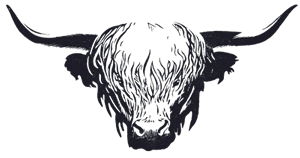
This famous sketch depicting the noble head of the Highland cow, adopted by breeders and breeders’ organisations all around the globe, was first used to preface “In Retrospect”, a short account of the founding of the Highland Cattle Society of Scotland in 1884, including the description of the breed unchanged to this day.
The Society is very proud indeed to have created such a popular and enduring icon of the Highlander that binds the worldwide community of Highland cattle breeders.
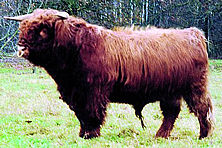
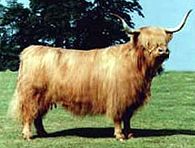
THE VARIOUS POINTS OF THE HIGHLANDER MAY BE NOTED AS FOLLOWS:
HEAD
Of all the representatives of our British bovine breeds, the Highlander has the grandest and most picturesque head; it is, indeed, to his head that he owes his great favour among artists. As a rule, it is most proportionate to the body of the animal, and is broad between the eyes, while short from the eyes to the point of the muzzle. The forelock between the eyes should be wide, long and bushy, and any nakedness or bareness there is certain to detract from the appearance of the animal. Some would almost have the hair so wide there as to obscure the eyes, but this in many cases would be allowing one good point to over-shadow another. The eyes should be bright and full, and denoting, when excited, high courage. When viewed sideways, there should be a proportionate breadth of the jawbones readily observable, when compared with the width of the head in front, whilst the muzzle should, when looked at from a similar point, be short, though very broad in front, and with the nostrils fully distended, and indicating breeding in every way. One of the most noteworthy features in a Highlander, is of course, the horns. In the bulls, the horns should be strong, and come level out of the head, slightly inclining forwards, and also slightly rising towards the points. Some, however, do not care for this rise, though any drooping is considered to be a very bad fault when between the crown and the commencement of the curve, as this is generally accompanied by a low weak back. Some, too, are of opinion that the masculine appearance is slightly detracted from when the horns rise directly from the crown. This, however, can only readily be detected and commented upon when particular animals are brought before experienced judges, as within a show ring.
As regards the horns of the cow, there prevail two opinions. As a rule, they come squarer out from the head than in the male, rise sooner, and are somewhat longer, though they preserve their substance and a rich reddish appearance to the very tips. The lack of the appearance of substance or “sappiness” about the horns of the male would be very much against the animal in the show-yard. The other taste is that for a female, the horns of which come more level from the head, with a peculiar back set curve, and very wide sweep. A large number of enthusiastic breeders seem to prefer, by comparison, the latter, which gives possibly the more graceful appearance. In all cases, however, the horns of a Highlander, when well set, gives the animal a stamp of nobility which causes it to attract the attention of any stranger who might pass heedlessly by animals of other breeds as merely cows, bulls or oxen.
THE NECK AND SHOULDER
The neck should be altogether clear and without dewlap below. It should form a straight line from the head to the shoulder in the cow, but in the bulls should have that distinct crest common to all animals of the bovine species. This crest should come gracefully down to the roots of the horns, and, being well coated with wavy hair, the masculine appearance of the animal is fully completed. The shoulder should be thick and should fill out greatly as it descends from the point to the lower extremity of the forearm.
BACK, BODY, AND HIND-QUARTERS
From behind the shoulder the back should be fully developed and beautifully rounded. Any slight sinking or hollow is most decidedly objectionable. It should also, as in the Ayrshire, be as straight as possible, and the ribs should spring boldly out and be both well rounded and deep. When measured across the hips the breadth should be very great, and the quarters should be exceedingly well developed from the hips backwards. The thighs should also be well developed, and should show great fullness. Viewed generally, the quarters should be square between the hips and the tail, and from between the tail right down to between the hind feet. The legs, both before and behind, should be short and strong, the bones strong, broad, and straight, the hoofs well set in and large, and the legs well feathered with hair. The animal should be set wide between the fore-legs, and it should move with great dignity and style, as this is considered to be one of the most reliable evidences of careful and true breeding.
HAIR
The hair, of which there should be a great profusion, more particularly on the parts indicated, should be long and gracefully waved, very much as in what dog-breeders denote wavy-coated retrievers. To have a curl is to possess a decided fault, and one which has of late years become unfortunately too common in some folds. This has been attributed in some quarters to a growing desire to make Highlanders grow big from feeding them higher and housing them more. At any rate, experience goes far to prove that the more exposed they are the greater the profusion of the hair, and the less its tendency to curl. Thus, the reason of the island cattle being always so much better haired than the mainland cattle is owing to their never being housed in winter.
The usual colours are black, brindled, red, yellow, and dun, and there is considerable difference of opinion among breeders as to which is preferable.
In general, as to colour, it may be said that a good herd should possess a mixture – avoiding always all those which indicate unhealthy thrivers. The thickness of the skin, as in all fattening breeds, comes in for a considerable amount of attention, but it has to be borne in mind always that the Highlander has been adapted by nature to withstand great exposure.
Inverness, 10th June, 1885.
Source: Highland Cattle Society